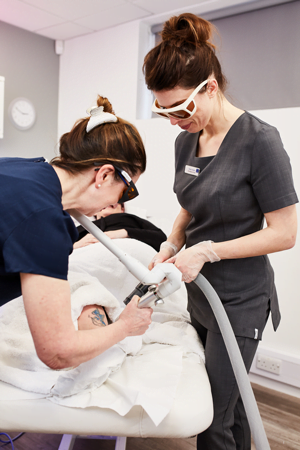
How do we keep laser and IPL treatments safe for patients while ensuring regulation remains practical for clinics?
That’s the focus of a Journal of Aesthetic Nursing paper co-authored by Lynton’s Dr. Samantha Hills (Clinical Director at Lynton and Honorary Lecturer at The University of Manchester) and Jonathan Exley (Director at Lynton Lasers Ltd and Honorary Secretary of the British Medical Laser Association), alongside Godfrey Town and Ross Martin, written on behalf of the British Medical Laser Association (BMLA).
The paper responds to the Department of Health & Social Care (DHSC) consultation on licensing non-surgical cosmetic procedures in England, with a specific aim: to ensure laser and IPL are regulated proportionately, based on real-world risk and evidence rather than assumption.
Why This Matters for Clinics Right Now
Proposed licensing for non-surgical cosmetic procedures in England isn’t simply a matter of policy discussion — it has real implications for how clinics operate day to day.
Under the DHSC’s plans, both practitioners and the premises they operate from will need to be licensed for in-scope procedures. Laser and IPL treatments fall within scope of this new regime, meaning clinics may need to demonstrate that their practitioners, premises and oversight arrangements meet defined standards. For many clinics, the concern isn’t regulation itself, but whether those requirements will be practical, proportionate and grounded in evidence.
This is where the BMLA’s paper is particularly relevant. Rather than treating all laser and IPL treatments as high risk by default, the authors set out an approach that reflects how these devices are actually used in real-world clinical settings, and how risks are already being effectively managed.
For clinics, the key takeaway is clear:
Patient safety is best supported through robust systems, training and protocols, rather than professional title alone.
The paper highlights that strong safety governance includes:
- Appropriate training, including MHRA-recognised Core of Knowledge
- Clear treatment protocols produced by an Expert Registered Healthcare Professional (ERHP)
- Support from a certified Laser Protection Adviser (LPA)
- A safe operating environment with defined local rules and protective measures
Clinics that already prioritise these elements are well placed to adapt as licensing frameworks continue to develop under the Health and Care Act 2022.
What DHSC Proposed and Why It Matters for Laser and IPL
As part of its consultation, the Department of Health and Social Care proposed a tiered risk classification for non-surgical cosmetic procedures:
- Green: lowest risk, practitioners can perform licensed procedures where agreed standards are met
- Amber: medium risk, non-healthcare professionals must be licensed and have oversight from a named regulated healthcare professional
- Red: highest risk, restricted to qualified and regulated healthcare professionals
The BMLA paper focuses on where laser, IPL and other energy-based devices sit within this framework, and how oversight can be applied in a way that is proportionate to risk.
Understanding the Real Risks of Energy-Based Devices
Laser and IPL treatments are widely used and can be very safe when delivered correctly. However, the paper is clear that they are not without risk.
One of the most important distinctions highlighted is that laser and IPL carry a unique hazard: the risk of ocular injury. Laser beams can be extremely intense and, in some cases, invisible to the human eye while still capable of causing harm.
This underlines why appropriate safety protocols, eye protection and controlled treatment environments are essential — and why regulation needs to be informed by how these risks arise and how they are best mitigated. Importantly, the paper also notes that serious adverse events are extremely rare when laser and IPL treatments are delivered within appropriate safety frameworks.
The Five Types of Adverse Incidents Identified in the Paper
Rather than treating risk as a vague concept, the paper categorises adverse incidents into five defined types:
- Unintentional eye exposure affecting the client or operator
- Tissue injury linked to device component failure
- Tissue injury caused by operator error, such as incorrect settings or missed contraindications
- Complications arising from poor client compliance before or after treatment
- Technical incidents without injury, including calibration or equipment issues
A recurring theme is that many adverse outcomes are preventable through appropriate training, protocols, maintenance and a strong safety culture.
Oversight That Matches Risk, Not Assumptions
The paper examines what “oversight” should mean for laser and IPL treatments classified as amber risk.
Rather than assuming a regulated healthcare professional must be physically present for every treatment, the BMLA proposes a proportionate model that includes:
- Direct oversight, where timely in-person intervention could improve outcomes
- Indirect oversight, delivered through written treatment protocols and remote availability where appropriate
The paper makes clear that oversight can be delivered through protocols produced by an Expert Registered Healthcare Professional (ERHP), supported by appropriate safety systems. This reflects real-world practice, where most laser/IPL complications are mild and transient when devices are used correctly, while serious concerns such as suspected eye injury require immediate referral.
Training, Competence and the Core of Knowledge
The paper also tackles the hot-button issue of who is actually qualified to perform laser treatments.
Traditionally, greater emphasis has been placed on professional title (such as doctor versus therapist), but the authors emphasise the importance of training and competence. In their view, it’s less about what’s on your badge and more about what you know and how safely you work. They are not suggesting that just anyone can operate a laser — but it’s not limited to doctors alone either.
The paper recommends that all practitioners complete the MHRA-approved Core of Knowledge safety training, which is widely recognised as the gold standard for understanding how light-based devices interact with the skin, eyes and treatment environment.
Why the BMLA’s Contribution Matters For Your Clinic
This publication is part of a much bigger conversation about how we in the UK define safety, accountability and professionalism.
As a leading manufacturer of British-made laser and IPL technology, Lynton strongly supports the BMLA’s efforts to promote high standards and protect clients across the industry.
The BMLA’s contribution ensures that laser and IPL devices are properly understood and regulated within that framework, rather than lumped in with injectables or overlooked altogether.
It’s a more pragmatic proposal that could help regulators protect the public without suffocating clinics with stuffy and outdated regulatory standards. As the aesthetics and medical fields continue to advance over time, so should the standards by which they’re judged in terms of patient safety.
After all, if new evidence suggests that risks can be adequately managed in a tiered system, then this works best not just for patients but for clinics too. Its especially relevant now as new licensing frameworks are being developed under the Health and Care Act 2022.
Interested in Reading the Full Paper?
The use of energy-based devices in non-surgical cosmetic treatments: risks and regulations
Journal of Aesthetic Nursing, July 2025
DOI: 10.12968/joan.2025.0019
https://www.magonlinelibrary.com/doi/abs/10.12968/joan.2025.0019